
By the Prosound production team · Updated 28 November 2026 · About 8 minutes to read
Quick answer
A conference projector is sized from the screen area and the light in the room, not from the projector’s badge. Budget 1,000 to 1,500 lumens per square metre of screen for a ballroom with house lights up, and roughly half that for a blacked-out room. Then check the throw ratio against the real projection distance before the lens is ordered.
Most projector enquiries for a Hong Kong conference arrive as a single line: a room, a date, and a screen size. The screen size is useful, but the number that decides whether the image holds up is the light already in the room. A 10,000 lumen projector that looks washed out in a ballroom with the chandeliers at 80 percent will look perfectly punchy in the same room with the front half dimmed.
This guide covers the four decisions that actually determine a conference projection setup in Hong Kong: how many lumens the screen needs, which lens the throw distance allows, what screen surface suits a wide seating plan, and when a single projector should become two blended or stacked units. It is written from the production side, where the constraint is always the venue rather than the catalogue.
Everything below applies to front projection in hotel ballrooms, convention centre meeting rooms and corporate auditoriums. Where an LED wall is the better answer, that is noted, because the two technologies solve different problems.
Key takeaways
- Lumens scale with screen area: a 4 × 2.25 m 16:9 screen is about 9 m², so a lit ballroom needs roughly 9,000–13,500 lumens.
- Throw ratio is throw distance divided by screen width. An 8 m throw onto a 4 m wide screen needs a 2.0:1 lens, and no amount of keystone fixes a lens that is wrong.
- Screen gain above 1.2 narrows the viewing cone and creates a hotspot; for wide banquet seating a matte white surface at gain 1.0 is usually the better trade.
- Edge blending joins two projectors into one wide canvas with 10–20 percent overlap; stacking two units doubles brightness or buys redundancy.
- Projector rental in Hong Kong typically runs HK$2,000–3,000 per unit per day depending on model and venue; lenses, screens, rigging, crew and transport are quoted separately.
How many lumens does a conference projector need?
The lumen figure is set by screen area and ambient light, and it can be calculated before anyone quotes a model. A working rule for front projection is 1,000 to 1,500 lumens per square metre of screen surface when the audience needs to read slides with house lights up, and 500 to 750 lumens per square metre when the room can be properly dimmed.
Take a common conference setup: a 4 m wide 16:9 screen is 2.25 m tall, so about 9 m² of surface. With lights up that points to 9,000–13,500 lumens; blacked out, 4,500–6,800 lumens is enough. A 6 m wide screen is roughly 20 m², which pushes the requirement to 20,000–30,000 lumens — a class of projector that usually means two blended units rather than one large chassis.
Ambient light is the variable that ruins the calculation when it is ignored. Hotel ballrooms are lit for dining and photography, not for projection, and the light falling on the screen surface is what destroys contrast. Before specifying a bigger projector, check whether the front-of-house lighting circuits over the screen can be dimmed separately. Dimming two circuits is often cheaper and faster than renting a brighter machine.
Laser projectors are now the default for conference work because they reach full brightness instantly, need no lamp change mid-event, and hold their output as they age. Lamp-based units still appear for smaller breakout rooms where the budget is tighter and the throw is short. If you want that figure checked against a specific room before you commit, our projector rental service will confirm what is available and which lens each unit ships with.
- 3 × 1.7 m screen (≈5 m²): 5,000–7,500 lumens with lights up
- 4 × 2.25 m screen (9 m²): 9,000–13,500 lumens with lights up, 4,500–6,800 dimmed
- 6 × 3.4 m screen (≈20 m²): 20,000–30,000 lumens, normally two blended units
- Blacked-out room: halve the figures, then add 20 percent headroom for lamp or laser ageing
| Screen (16:9) | Area | Lit room | Dimmed room | Typical approach |
|---|---|---|---|---|
| 3 × 1.7 m | 5 m² | 5,000–7,500 lm | 2,500–3,800 lm | Single 6,000-lumen class unit |
| 4 × 2.25 m | 9 m² | 9,000–13,500 lm | 4,500–6,800 lm | Single 10,000–15,000 lm laser |
| 6 × 3.4 m | 20 m² | 20,000–30,000 lm | 10,000–15,000 lm | Two blended or stacked units |
| 8 × 4.5 m | 36 m² | 36,000–54,000 lm | 18,000–27,000 lm | Blended pair plus consideration of LED wall |
How do you work out throw ratio and choose the right lens?
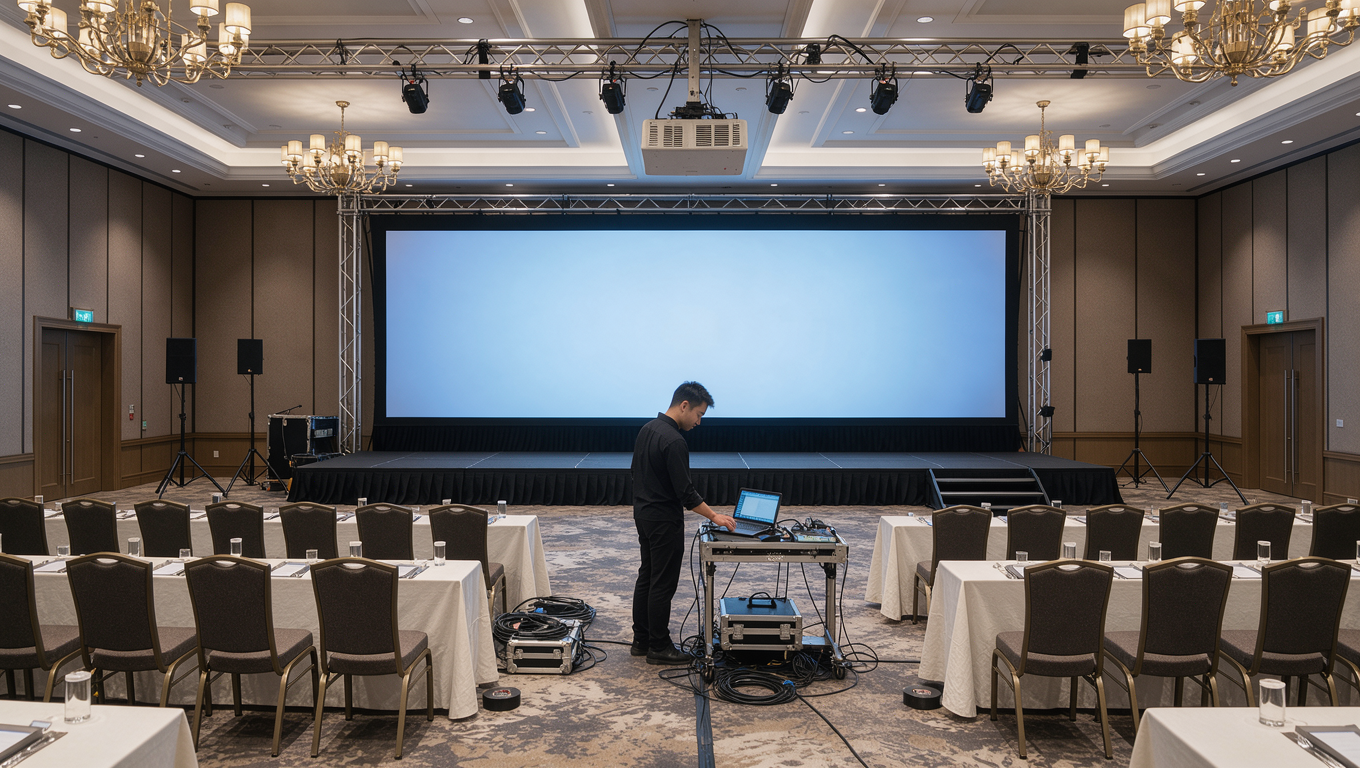
Throw ratio is the projection distance divided by the screen width, and it decides whether a projector can fill the screen from where the venue allows it to hang. An 8 m throw onto a 4 m wide screen is a throw ratio of 2.0:1, so the projector needs a lens covering 2.0:1 — a 1.5–2.0:1 zoom at its long end, or a fixed 2.0:1 lens.
Do the sum before the venue visit is booked, not after. Ceiling height, rigging points and the front row of seating all constrain where the machine can sit, and a room where the only practical hanging point is 6 m from a 4 m screen needs a 1.5:1 lens or wider. Getting that wrong is the single most common reason a projection setup is re-planned on site.
Lens shift is the correct tool for alignment, not keystone. Most conference projectors allow vertical shift of 50–60 percent and horizontal shift of 10–30 percent, which covers typical mounting offsets without touching the geometry. Digital keystone crops and resamples the image, costing resolution and producing visibly soft edges on text and thin graphics — exactly the content a conference shows.
Match the native aspect ratio to the content, not to the screen. A 16:10 projector filling a 16:9 screen loses a strip of pixels or letterboxes; a 16:9 projector on a 4:3 screen wastes brightness outside the picture. If the deck is 16:9 and the venue screen is 4:3, agree on which one changes before the shoot day. For rooms where the projector cannot sit far enough back at all, a short-throw lens at 0.8:1 will fill a 4 m screen from 3.2 m.
- Throw ratio = distance ÷ screen width. Measure both in the same units.
- 8 m throw, 4 m screen → 2.0:1 lens
- 6 m throw, 4 m screen → 1.5:1 lens
- 3.2 m throw, 4 m screen → 0.8:1 short-throw lens
- Allow 10 percent margin on the zoom range so the lens is not pinned at one end
Does screen gain matter as much as projector brightness?
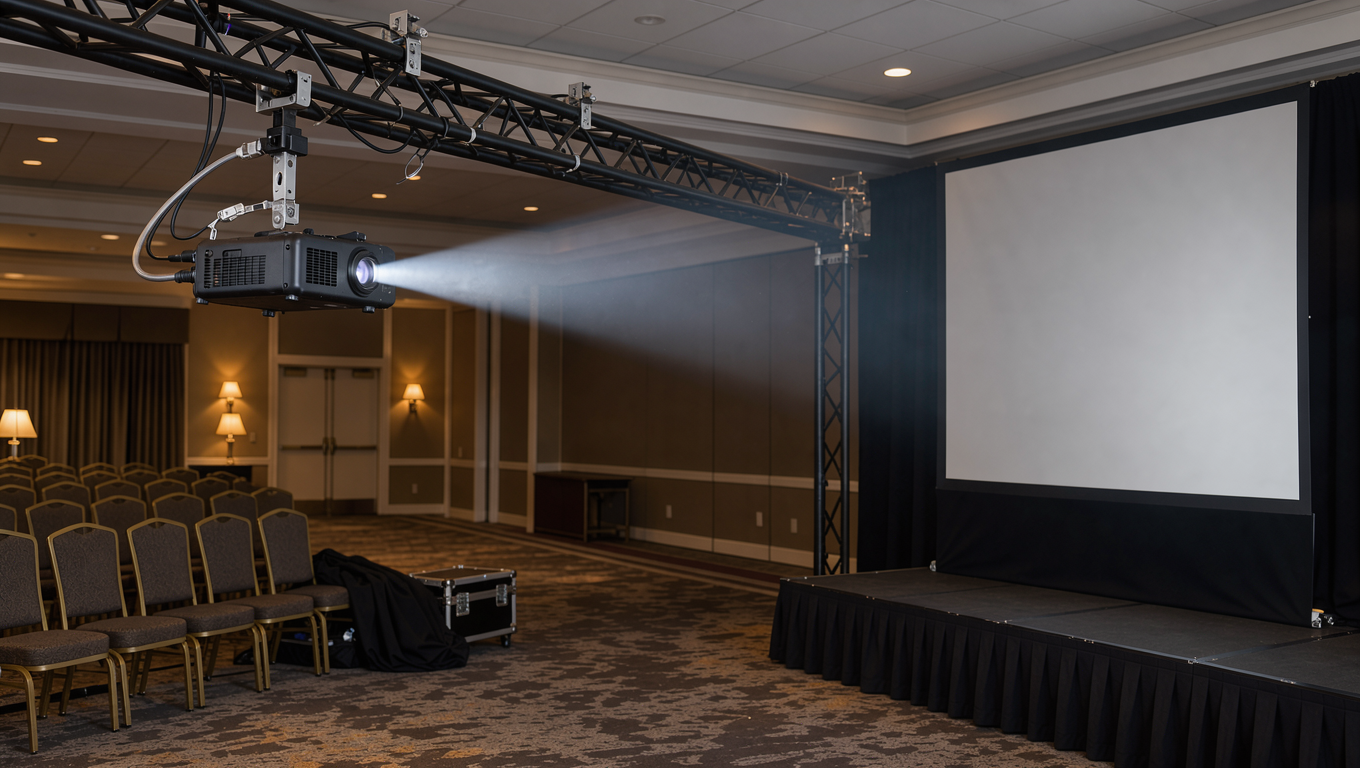
Screen gain matters, but usually in the opposite direction to what clients expect. Gain measures how much light a surface reflects back towards the audience compared with a perfect diffuser. A gain of 1.0 is a standard matte white surface; 1.3 or higher concentrates light into a narrower cone, which makes the image brighter on axis and dimmer at the sides of a wide room.
In a ballroom with seating spread across 25 m and guests at 45 degrees off axis, a high-gain screen produces a bright hotspot in the middle and a visibly duller picture at the edges, and cameras covering the event see it as a hot patch. A matte white surface at gain 1.0 to 1.1 holds brightness more evenly across the seating plan. Unless the room is narrow and the audience is centred, gain above 1.2 is the wrong choice.
Grey screens work the other way: a gain of 0.7 to 0.8 reflects less light but deepens blacks, which reads as better contrast when ambient light cannot be controlled. The cost is that every lumen has to work harder, so a grey surface and a bright projector are a package decision rather than two separate ones.
Screen size is the variable that quietly breaks the budget. Widening a 4 m screen to 5 m increases area by 56 percent, not 25 percent, so brightness per square metre drops by a third unless the projector changes too. Any late change to screen size should trigger a re-check of the lumen maths. Where the screen has to be very large and the room cannot be dimmed, an LED wall at P2.84 removes the ambient light problem entirely, at a different cost profile — our comparison of LED walls and projectors for corporate events sets out the trade-offs.
- Gain 1.0–1.1 matte white: widest viewing angle, the safe default for banquet seating
- Gain 1.3–1.8: brighter on axis, hotspot and fall-off off axis — only for narrow rooms
- Gain 0.7–0.8 grey: better perceived contrast in ambient light, needs more lumens
- Going from a 4 m to a 5 m wide screen adds 56 percent more area — re-check brightness
When do you need edge blending or a stacked pair?
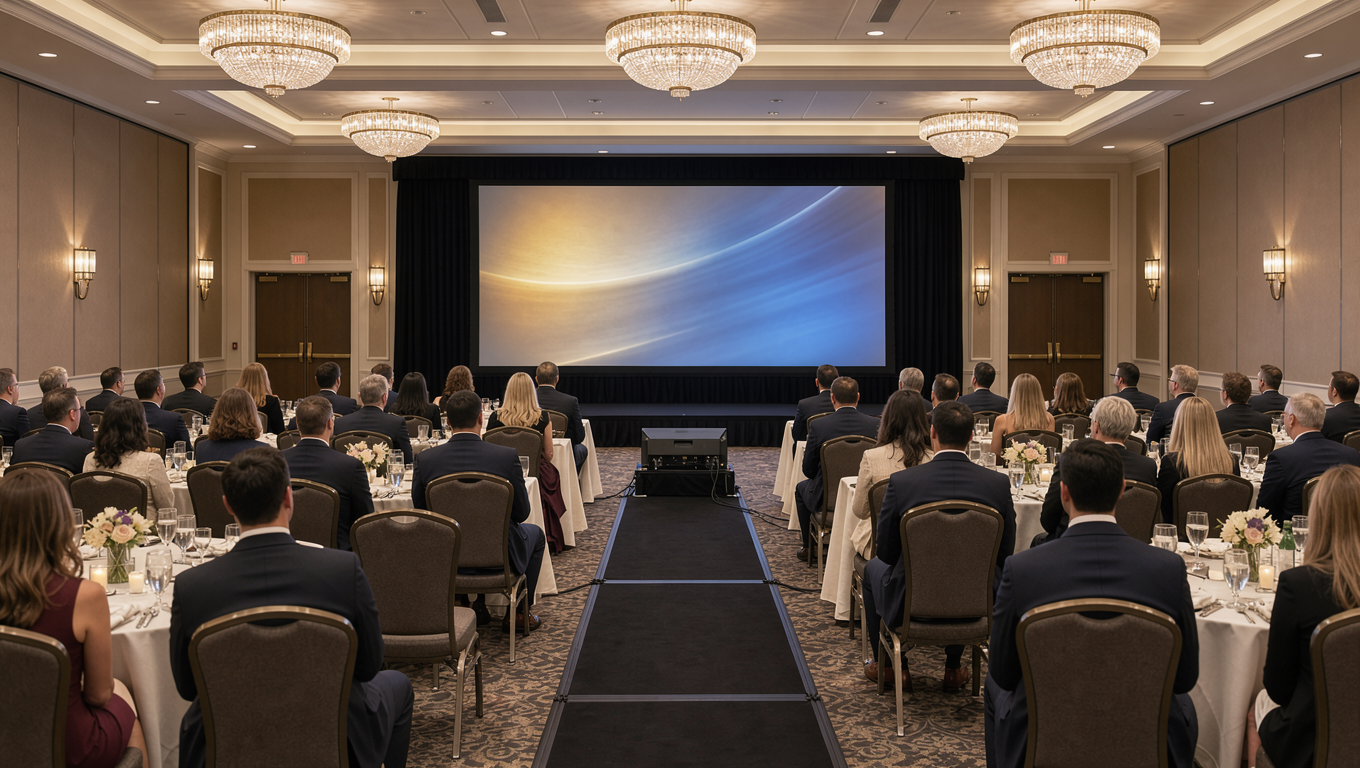
Edge blending is needed when the content is wider than any single projector can fill at the available brightness, typically a panoramic backdrop of 8 m or more, or a 2.35:1 stage canvas. Two projectors sit side by side, their images overlap by 10 to 20 percent, and a blend curve in the processor feathers the overlap so the seam disappears.
A blended pair has to be treated as one system. Both projectors should be the same model with the same lens and similar hours, both fed from the same source and colour-matched, and both aligned to the same geometry. Mixing models or lamp ages shows up as a visible brightness step down the middle of the image, which is far more noticeable than a slightly softer picture overall.
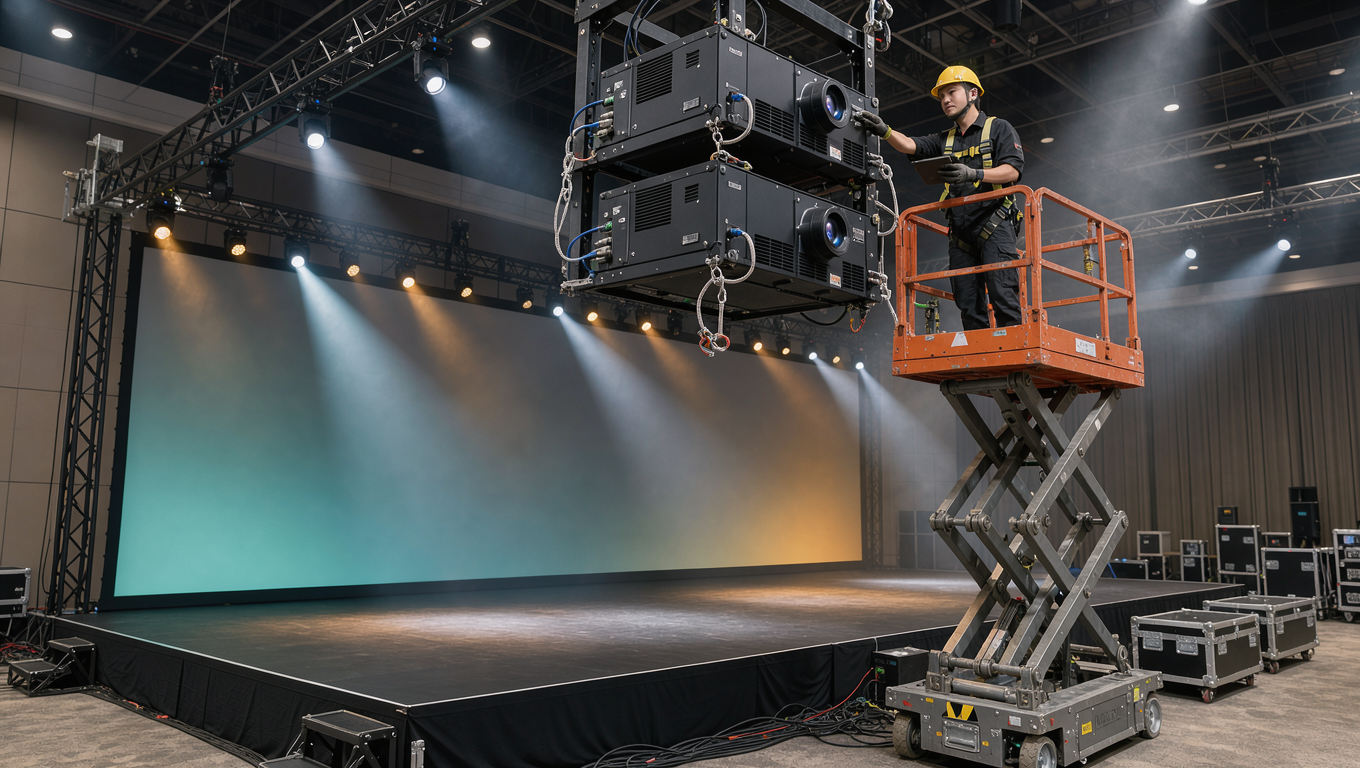
Stacking is a different technique for a different problem. Two projectors are aimed at the same screen, one above the other, so their light output adds. That doubles brightness on a large screen, or provides redundancy: if one unit fails, the show continues at half brightness while the spare is swapped. Stacking needs precise alignment and a switcher that can fail over cleanly, and it needs the rigging to carry twice the weight.
Both approaches add lead time. Blending requires content delivered at the blended canvas resolution, not two separate halves, and it requires an on-site alignment session with the room at show lighting. Budget that into the load-in schedule: a blended pair typically needs two to three hours of alignment after the projectors are hung, before content testing begins.
- Edge blending: wide or ultra-wide canvas, 10–20 percent overlap, one continuous source
- Stacking: double brightness or redundancy on the same screen area
- Same model, same lens, matched hours — mismatched units show a seam or a step
- Content must be mastered to the blended resolution, not delivered as two halves
- Allow 2–3 hours of alignment on site with show lighting before content testing
Frequently asked questions
How much does it cost to rent a projector in Hong Kong?
Projector rental in Hong Kong typically runs about HK$2,000–3,000 per unit per day, depending on the model and the venue. Lenses, screen hire, rigging, technical crew and transport are quoted as separate lines, so compare quotations on the full package rather than the daily projector rate alone.
How many lumens do I need for a 4 metre screen in a hotel ballroom?
A 4 m wide 16:9 screen is about 9 m². With house lights up, plan for 9,000–13,500 lumens; with the room properly dimmed, 4,500–6,800 lumens is enough. If the lights over the screen cannot be dimmed, treat the higher figure as the minimum and ask whether a brighter unit is available for the date.
How far back does the projector need to be for a 4 metre wide screen?
It depends on the lens. At a 2.0:1 throw ratio the projector sits 8 m back; at 1.5:1 it sits 6 m back; a 0.8:1 short-throw lens fills the same screen from about 3.2 m. Confirm the actual hanging position with the venue before the lens is booked, because ceiling height and rigging points often rule out the ideal distance.
Can you project onto the ballroom wall instead of a screen?
Rarely advisable. Wall colour and texture distort the image, glossy finishes create hotspots, and the gain is unknown, so brightness calculations no longer hold. A tensioned screen also gives a defined edge that a wall cannot, which matters for branding and camera framing. If the wall is the only option, a grey surface treatment and a brighter projector can make it workable.
Do you provide a technician with the projector rental?
Yes. Conference work normally includes an on-site technician for setup, focus, source switching and standby during the session. Larger setups with blended pairs or multiple rooms are crewed accordingly, and rehearsal time is scheduled in the load-in window rather than on the morning of the event.
Should I use a projector or an LED wall for a conference?
A projector is usually the right answer when the room can be dimmed and the screen sits behind a stage at a distance from the audience. An LED wall wins when the room cannot be darkened, when the screen is very large, or when the wall is close to the audience or on camera. Our rental LED wall is P2.84, which stays sharp from about 5 m.
Planning projection for a conference or ballroom in Hong Kong? Send us the venue, date and screen size.