
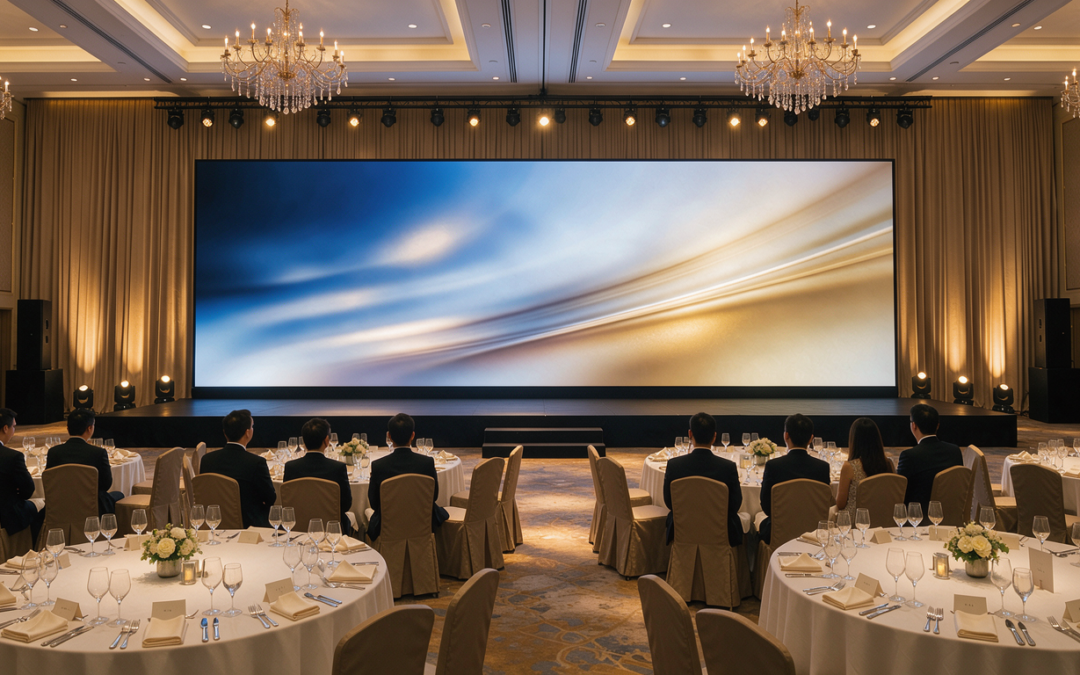
By the Prosound production team · Updated 19 November 2026 · About 8 minutes to read
Quick answer
An LED wall rental in Hong Kong is specified by three numbers, not by size alone: the pixel pitch (our rental stock is P2.84 mm), the viewing distance of the furthest row, and the power available at the venue. Pixel pitch and the closest audience seat set the wall height; the furthest seat sets the resolution you can get away with; power and rigging decide whether the design is buildable at that venue. Get those three right before you discuss price.
Most LED wall enquiries start with a size: “we need a 6 by 3 metre wall”. Size is the least useful thing to fix first, because the same 6 by 3 rectangle can read as a crisp backdrop from row one and as a blocky screen from row fifteen, depending on the pitch and the resolution behind it.
This guide walks through how our production team actually specifies a wall for a corporate conference, a product launch or a hotel ballroom activation in Hong Kong. It covers the pixel-pitch and viewing-distance arithmetic, how cabinet counts turn into a working resolution, what power a wall of that size draws, and which venue questions have to be answered before the truss design is signed off.
Nothing here is brand-specific. The constraints are the same for any rental house: the audience’s eyes, the venue’s ceiling, and the building’s electrical supply.
Key takeaways
- Our rental LED wall is P2.84 mm pitch; a 500 × 500 mm cabinet carries 176 × 176 pixels.
- Sharpness is set by the nearest seat, not the furthest. Retina distance for P2.84 is roughly 10 m; comfortable viewing starts around 5 m; below 3 m the pixel grid becomes visible.
- Resolution is the wall size divided by the pitch: 6 × 3 m at P2.84 is about 2112 × 1056 pixels, comfortably above 1080p but short of 4K.
- Average draw for a rental LED wall is roughly 250–350 W per square metre, with peaks far higher on full-white content — always budget from the datasheet, then add headroom.
- One 13 A socket delivers about 2.8 kW usable. A 6 × 3 m wall at average draw sits near 5 kW, so it will not run from a single household circuit.
How does pixel pitch decide the size of an LED wall?
Pixel pitch is the distance between the centres of two adjacent LEDs, measured in millimetres. It determines how much detail the wall can carry and how close an audience can stand before the pixel grid becomes visible. The smaller the number, the finer the image and the more expensive the panel.
The human eye resolves roughly one arc-minute of detail. That works out to a practical rule of thumb: full “retina” sharpness arrives at a distance of about 3.4 times the pitch in metres. For P2.84 that is roughly 9.7 m. Comfortable viewing for a mixed audience starts at about 1.7 times the pitch, around 5 m, and below 1 times the pitch, around 3 m, individual pixels become obvious to a normal-sighted viewer.
In practice this means the front row decides your pitch. A wall behind a stage where the nearest guest is 12 m away will look immaculate at P2.84 even on a 10 m wide screen. The same wall placed as a low exhibition backdrop where visitors walk within 2 m will look coarse at 1080p content and will need to be designed around larger type, simpler graphics and slower movement.
This is the first conversation worth having with your AV supplier: tell them the closest seat, the furthest seat and the camera position, not just the width. Everything else follows. If you are still deciding between a wall and a projection, our comparison of LED walls and projectors for corporate events covers the brightness and sightline trade-offs.
- Nearest viewer within 3 m: use P2.84 only for bold graphics, or plan larger text and logos
- Nearest viewer 3–5 m: P2.84 is comfortable for presentations and video playback
- Nearest viewer beyond 10 m: P2.84 is sharper than the eye can resolve, so spend the budget on size instead of a finer pitch
- On-camera use: judge by the tightest camera shot, not the room; a close-up crop needs the same sharpness as a 2 m viewer
How do cabinet counts turn into resolution?
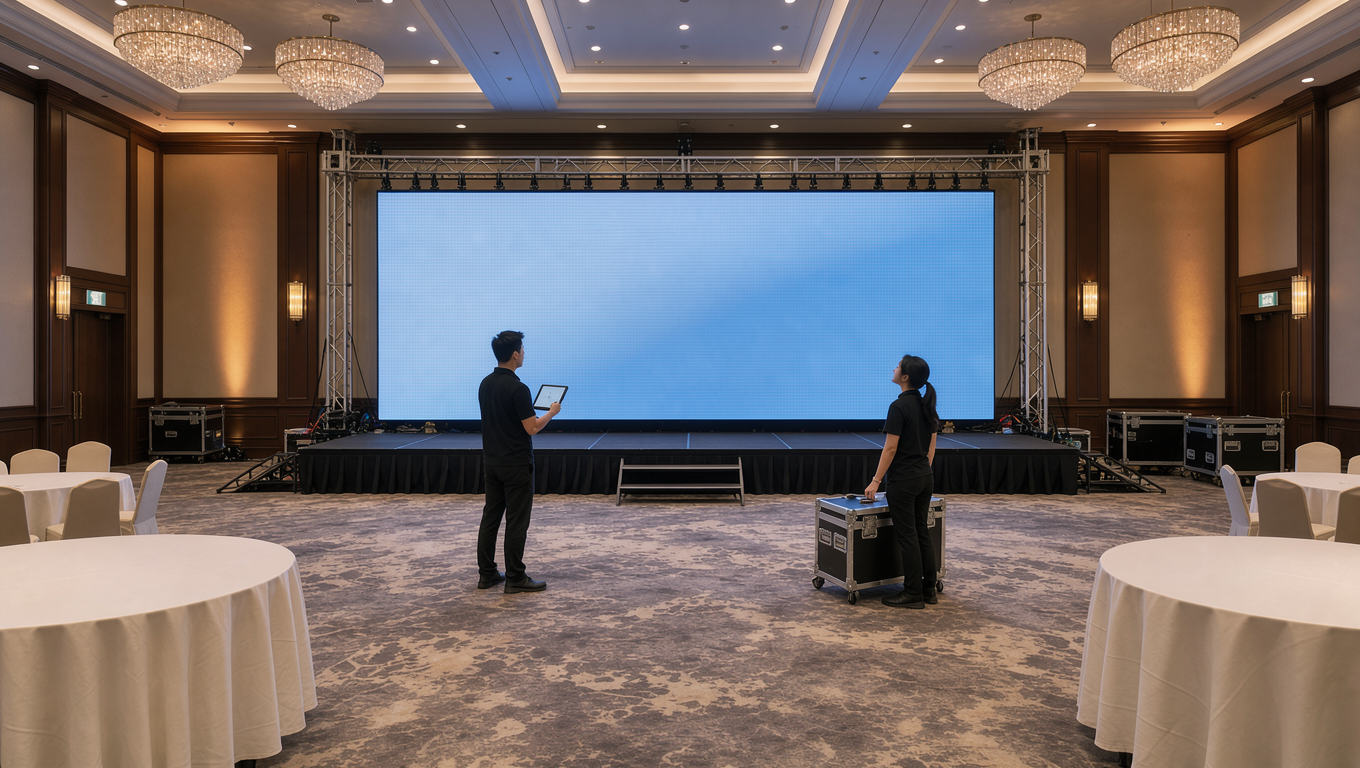
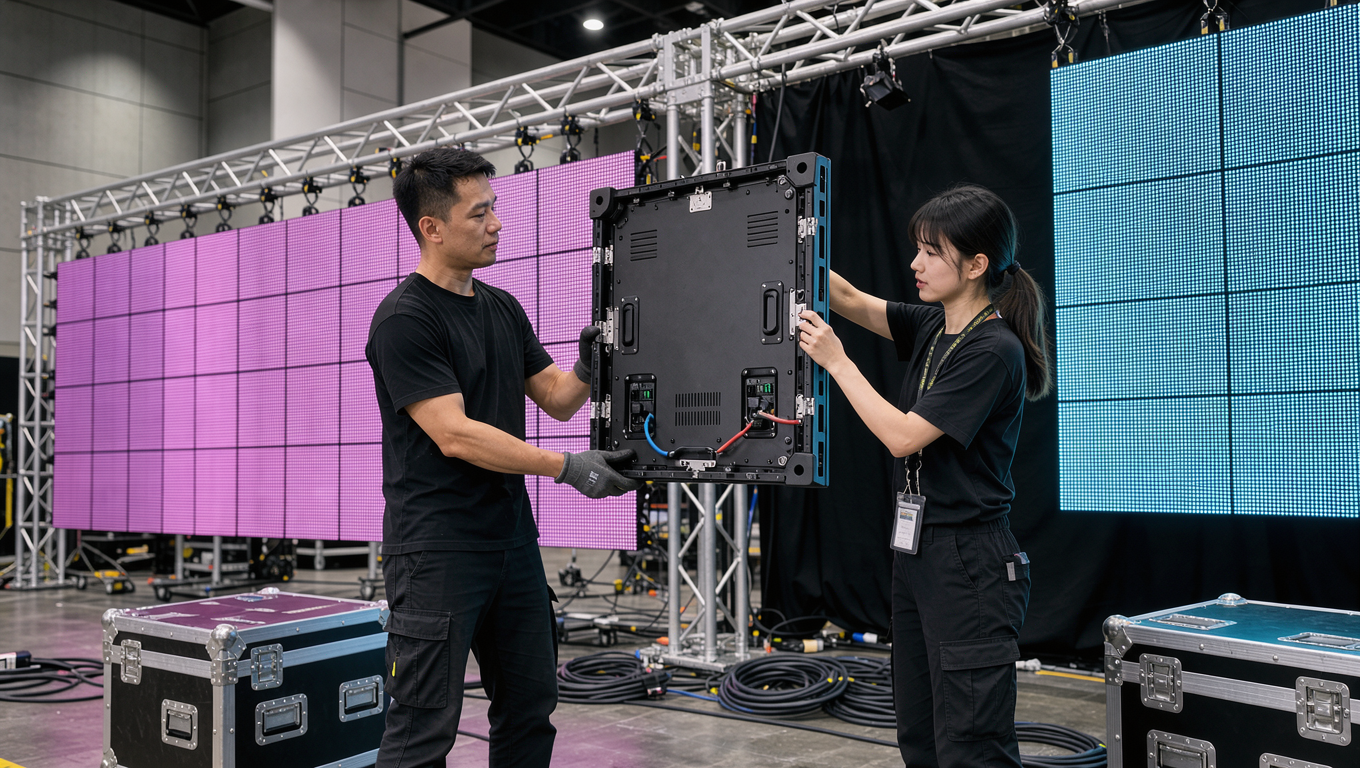
Rental walls are built from cabinets, and the cabinet grid is what actually constrains your size. A standard 500 × 500 mm cabinet at P2.84 mm pitch carries 176 × 176 pixels. At 2.84 mm per pixel, 500 mm of cabinet holds 176 pixels exactly, which is why 500 mm is the natural module for this pitch.
So the arithmetic is simple and worth doing yourself before the proposal arrives: divide the wall width in millimetres by 2.84 and you get the horizontal pixel count. A 6 m wall is 6000 ÷ 2.84 ≈ 2112 pixels. A 3 m height is 3000 ÷ 2.84 ≈ 1056 pixels. Both are multiples of 176, which tells you the wall is 12 cabinets wide and 6 cabinets high — 72 cabinets, 18 m² of surface.
That resolution matters because content is mastered at fixed sizes. 1920 × 1080 fits inside 2112 × 1056 with room to spare. A 4K master (3840 × 2160) will be scaled down, which is fine, but a 4K master shown on a 4 m wide P2.84 wall is wasted detail you cannot see. The reverse error is more common: 720p content blown up onto a wall that can resolve far more, which looks soft to the front rows even though the wall is capable.
Ask for the pixel dimensions on the drawing, not just the metre dimensions. Suppliers who quote only metres are usually leaving the content team to discover the mismatch later, and that conversation always happens closer to show day than anyone wants.
| Wall size at P2.84 | Cabinet grid | Pixel resolution | Best-fit content |
|---|---|---|---|
| 4 × 2.5 m | 8 × 5 | 1408 × 880 | 720p upscaled, graphics-led decks |
| 6 × 3 m | 12 × 6 | 2112 × 1056 | 1080p native, presentation and video |
| 8 × 4.5 m | 16 × 9 | 2816 × 1584 | 1080p with margin, IMAG wide shots |
| 12 × 6 m | 24 × 12 | 4224 × 2112 | Full 4K masters, wide ballroom backdrops |
How much power does a rental LED wall actually draw?
LED walls are efficient per unit of brightness, but they are large, and the numbers add up faster than clients expect. A reasonable planning figure for a rental wall running mixed content is 250–350 W per square metre average. A 6 × 3 m wall is 18 m², so budget roughly 4.5–6.3 kW average, and plan the supply for peaks closer to 600 W per square metre on sustained white content — product launches with full-white transitions are the classic case.
Hong Kong venue power is usually described in amps, not watts. A standard 13 A socket gives you about 2.8 kW usable (13 A × 220 V, minus a safety margin). A 32 A single-phase supply gives roughly 7 kW. A 63 A three-phase supply gives about 13.8 kW per phase, roughly 41 kW in total if balanced across phases. That means a single 13 A socket is not enough for a 6 × 3 m wall, let alone the wall plus lighting plus sound.
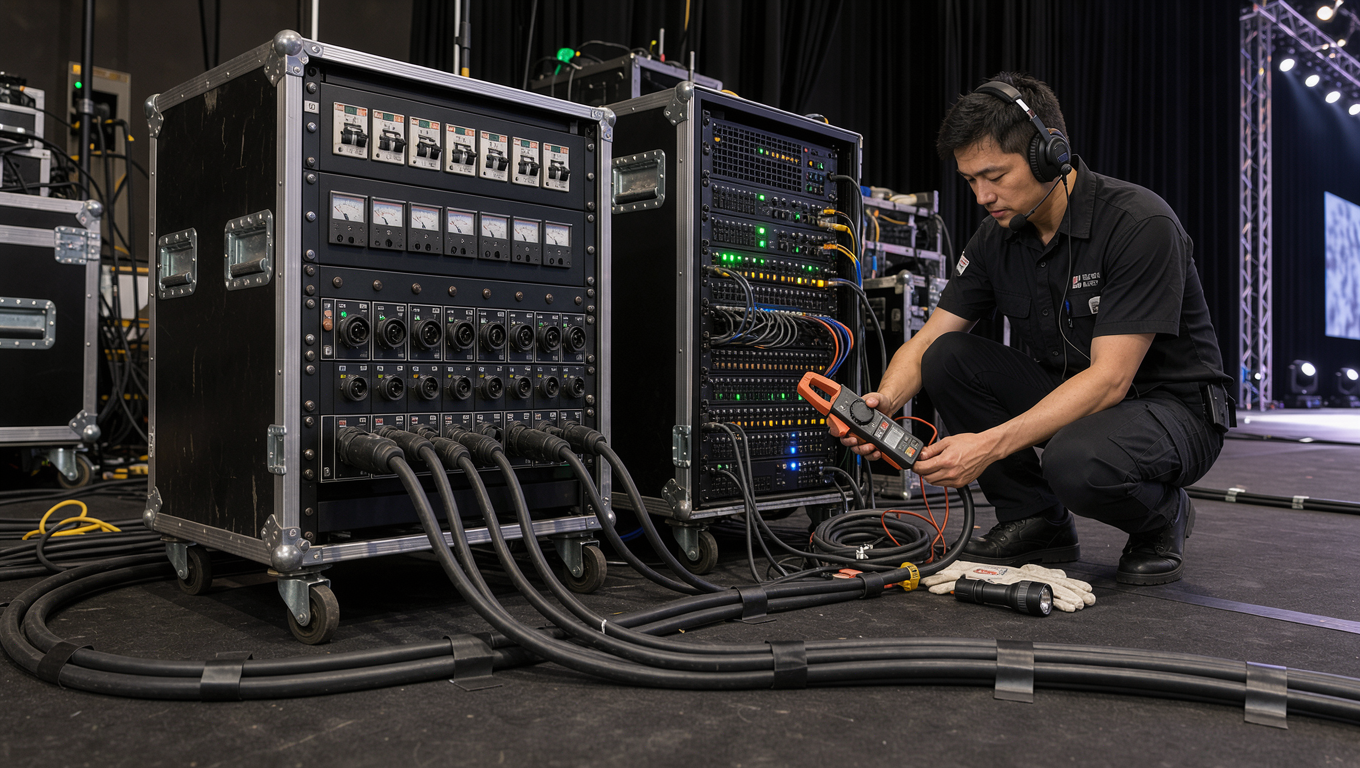
The safe pattern is to split the wall across two or three separate circuits, each protected and each with its own cable path back to the distribution board, then keep lighting on a different phase so that a lighting dimmer fault cannot take the screen down. Sending a wall to a hotel ballroom on one circuit is the most common cause of a screen that dims every time the house lights are brought up.
If the venue’s supply is thin or the load-in is outdoors, a generator changes the planning: you need to size for peak, not average, and you need a clean earth reference. We size generator capacity at roughly 1.5 times the calculated peak load, and we test the wall on the generator before doors rather than during the opening titles.
- 13 A socket ≈ 2.8 kW usable — enough for a small 2 × 1.5 m wall, not a ballroom backdrop
- 32 A single phase ≈ 7 kW — a 6 × 3 m wall plus processors, with little left over
- 63 A three phase ≈ 41 kW balanced — wall, lighting and sound on separate phases
- Always add 20–30% headroom for inrush, ambient heat and processing
What has to be confirmed at the venue before the design is fixed?
Three venue facts change the design more than any creative decision: ceiling height, rigging permission and load-in access. In Hong Kong, hotel ballrooms typically offer 4–6 m clear height with rigging points at fixed positions rated for a stated load per point; the convention centre halls offer far more height but require a rigging plan submitted in advance and approved by the venue’s technical team. Ground-supported walls avoid rigging approval entirely but eat floor area and sightlines.
Ask for the venue’s technical pack before the quotation is finalised. It should state clear height, rigging point positions and SWL, door and lift dimensions for flight cases, freight lift booking rules, and the electrical supply available at the loading dock and on stage. A 500 mm cabinet case is around 1.2 m tall; if the service lift is smaller than that, the whole wall has to travel by a different route and the schedule changes.
Load-in windows are the other constraint. Most Hong Kong venues allow overnight build with a hard stop before the morning session, which compresses the alignment and content test into a few hours. A wall that goes up at 2 a.m. and has to be pixel-perfect by 8 a.m. needs a crew that has built that exact configuration before — which is a reason to favour a supplier with the same cabinets and the same processors every time, rather than the cheapest quote for that week.
Once the design is settled, budget should be the last conversation, not the first. If you want a sense of what drives the number, our LED wall rental cost guide for Hong Kong breaks down the cost lines, and our production team can quote against your venue’s technical pack.
- Clear height and rigging point SWL, in writing, from the venue technical pack
- Cabinet case dimensions versus service lift and doorway widths
- Power available at stage and at the loading dock, with phase information
- Load-in window, overnight restrictions and strike deadline
- Whether the venue requires its own rigging contractor or structural sign-off
Frequently asked questions
How much does it cost to rent an LED wall in Hong Kong?
The number is driven by wall area, pitch, rigging method, crew and transport rather than by a single day rate. As a planning reference, an indoor wall for a one-day corporate event in Hong Kong commonly lands in the low tens of thousands of Hong Kong dollars once structure, crew and power distribution are included. Request a quote against your venue’s technical pack for an accurate figure.
What pixel pitch do you recommend for a hotel ballroom?
P2.84 mm is the working standard for ballroom backdrops: it stays sharp from about 5 m and is beyond the eye’s resolution past about 10 m, which covers most banquet seating plans. If guests will stand within 2–3 m of the wall, plan content with larger type and simpler graphics, or move the wall further back.
How large an LED wall can I run on a standard 13 A socket?
About 2.8 kW usable, which realistically covers a small wall of 2 × 1.5 m plus processing. A 6 × 3 m wall draws roughly 4.5–6.3 kW average, so it needs at least a 32 A supply or two separate circuits.
Can an LED wall be ground-supported instead of rigged?
Yes. Ground support avoids rigging approval and venue structural sign-off, and is common in hotel ballrooms with fixed rigging points. The trade-off is floor space, sightline obstruction at the base, and a slower build if the room has restricted load-in.
How long does it take to build and test an LED wall?
A 6 × 3 m wall typically takes three to four hours to build, cable and align with a four-person crew, plus content playback testing. Larger walls and rigged configurations take longer, and the venue’s load-in window usually decides the schedule rather than the build itself.
Planning a wall for a specific venue in Hong Kong? Send us the venue and date.